Customer-facing software that earns trust every time it loads
A digital platform is where your customers, members, and partners actually meet your organization. We design and engineer the sites, portals, and applications that carry your brand and revenue — fast on the surface, dependable underneath, and built to grow with you.
Why organizations invest in a digital platform
For most organizations, the digital platform is the front door. It is where a first impression is formed, where a customer completes the task they came to do, and where they decide whether to come back. When it is quick and clear, it quietly compounds trust and revenue. When it is slow or confusing, it costs both — usually without anyone noticing the leak.
Investing in the platform is rarely about chasing the newest technology. It is about removing friction from the moments that matter: signing up, finding information, completing a purchase, getting support. Those moments are where growth is won or lost.
First
The primary way customers experience your brand
24/7
Always-on service without added headcount
Compounding
Every friction removed pays back repeatedly
Where organizations get stuck
These are the operational frictions we hear most often — the symptoms that usually mean the software is working against the business rather than for it.
An aging site that no longer reflects the business
The product has moved on but the platform hasn't. Content is hard to update, the design feels dated, and every small change needs a developer.
Customers stuck on the phone for routine tasks
Booking, account changes, and status checks all route through staff because there's no self-service, driving up cost and wait times.
A platform that buckles under real traffic
It works in a demo but slows or fails during launches, campaigns, or seasonal peaks — exactly when it matters most.
Disconnected tools and duplicated data
The public site, the portal, and internal systems don't talk to each other, so information is re-entered and quickly drifts out of sync.
Poor experience on the devices people actually use
The platform was built desktop-first and struggles on phones, where a growing share of visitors now arrive.
No clear view of how the platform is used
Decisions are made on hunches because there's no reliable analytics showing where users succeed or give up.
How we approach a digital platform
We treat a platform as a product, not a project that ends at launch. That means we start with the people who'll use it and the outcome you're paying for, then let the technology follow — rather than the other way around.
We build in small, reviewable increments so you see working software early and can steer as it takes shape. Performance, accessibility, and security are designed in from the first sprint, not retrofitted before launch.
User-first, then engineered
We map the real journeys people take, then build an interface and architecture that make those journeys effortless.
Performance as a feature
Speed and responsiveness are treated as requirements with budgets, measured continuously — not hoped for.
Accessible by default
Semantic markup, keyboard support, and contrast are part of the definition of done, so the platform works for everyone.
The forms Digital Platforms takes
Concrete examples of what we deliver — not a fixed menu. Every engagement is shaped around the problem in front of us.
Corporate websites
Fast, accessible marketing sites with a content model your team can update without a developer for every change.
Customer portals
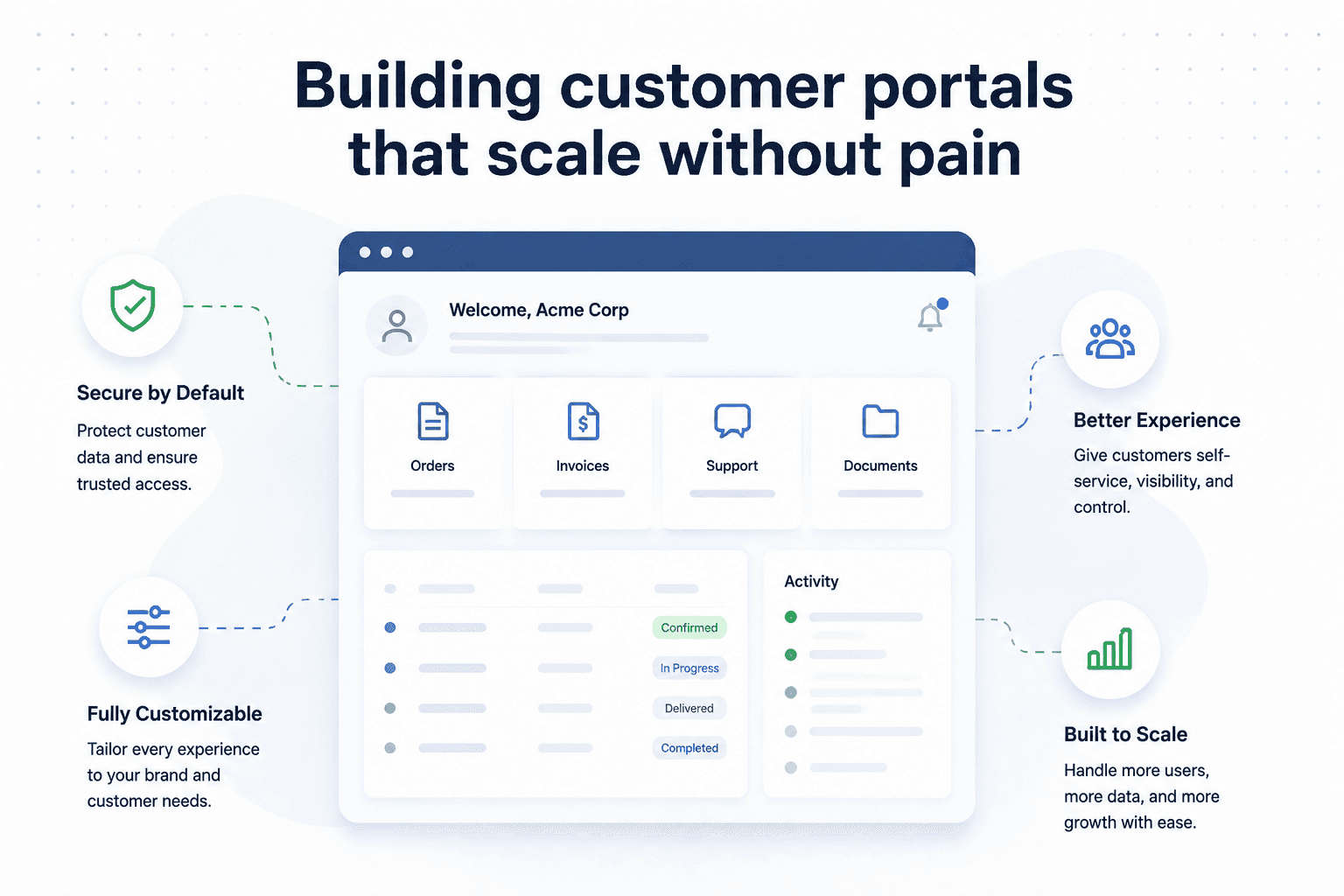
Secure, self-service portals where customers manage accounts, bookings, documents, and support in one place.
SaaS products
Multi-tenant applications with authentication, billing, and the reliability a product people pay for demands.
Dashboards & analytics
Interfaces that turn operational data into clear, timely decisions for the people who need them.
Internal portals
Web tools that give teams a single, reliable place to run day-to-day work instead of scattered spreadsheets.
Progressive web apps
Installable, offline-capable web apps that feel native and reach users without an app-store gatekeeper.
Who this is for
Digital platforms fit organizations where the software is the service — or fast becoming it. Across the sectors we work in, the pattern is the same: a customer-facing experience that needs to be dependable at scale.
Patient portals and booking systems that reduce phone load while respecting privacy and reliability.
Student and applicant portals that simplify communication and everyday administrative tasks.
Client portals and scheduling platforms that make a service business easier to work with.
Startups and scale-ups turning an idea into a SaaS product that has to hold up as usage climbs.
What you get from the work
The outcomes that make the investment worth it — not features, but the business value they create.
A better customer experience
Faster, clearer journeys that reduce drop-off and reflect the seriousness of your business.
Less manual, repetitive work
Self-service handles the routine, freeing your team for the work that actually needs a person.
Room to grow
An architecture that scales with traffic and features instead of forcing a costly rebuild later.
Reliable by design
Monitoring, testing, and sensible infrastructure so the platform stays up when it counts.
Decisions backed by data
Clear analytics show how the platform is really used, so you invest where it pays off.
Software that lasts
Tested, documented code other engineers can extend for years — not a black box only we understand.
How a project moves from idea to launch
Every engagement follows the same dependable rhythm — so you always know what stage we're in, what's next, and what you'll see along the way.
- 01
Discovery & Scoping
We learn your business, users, and the outcome worth building toward before any code is written.
- 02
Proposal & Alignment
We shape scope into a clear plan: what ships, in what order, and how we'll know it worked.
- 03
Design
We design the experience and the system beneath it, sized to your scale and budget.
- 04
Development
We build in short, reviewable increments so you see working software early and often.
- 05
Testing & QA
Automated and manual testing run throughout, so quality is built in rather than bolted on.
- 06
Launch & Handover
We ship to production with monitoring and documentation, keeping releases routine.
- 07
Ongoing Support
After launch we iterate on real usage and keep the platform healthy as needs evolve.
Further reading
Practical writing from the way we build software, relevant to this solution.
Questions worth asking first
The things clients most often want to understand before we begin.
Let's talk about your digital platforms project
Tell us what you're trying to build or improve. We'll help you shape the right approach and give you a clear path forward — no pressure, just a useful conversation.