When does your business actually need Odoo?
Odoo is powerful, but it isn't for everyone or every stage. Here are the signals that tell you the timing is right.
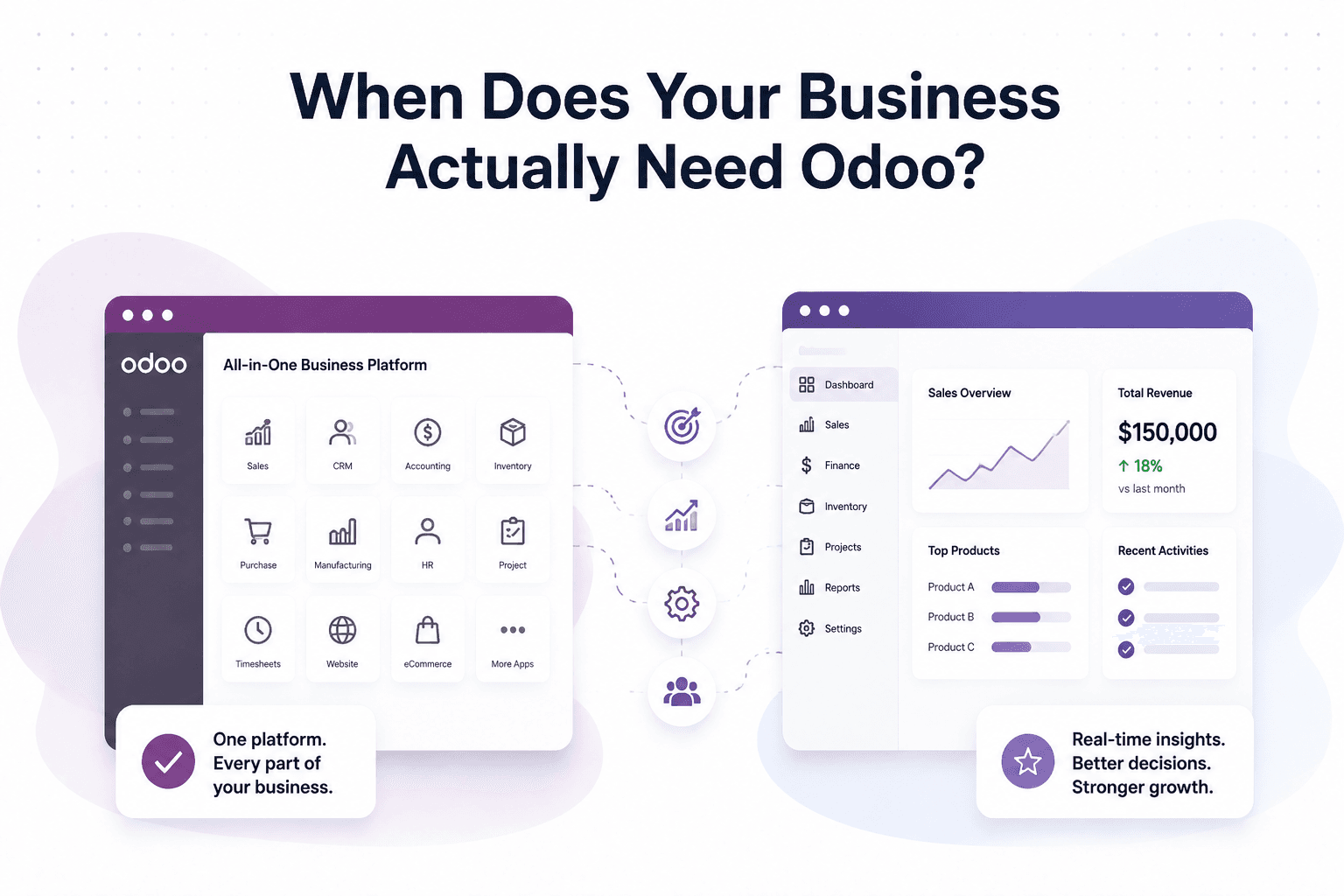
Odoo can run almost every part of a business, which is exactly why it's easy to adopt too early or for the wrong reasons. Here's how to tell when it genuinely fits.
You've hit the spreadsheet ceiling
The clearest signal is when spreadsheets stop scaling: the same numbers live in five files, people email versions back and forth, and no one is sure which is current. That friction is a tax on every decision.
- Data is rekeyed between tools by hand.
- Month-end reporting takes days of assembly.
- Teams disagree on the numbers because they're each looking at a different copy.
Timing matters
Adopt too early and the overhead outweighs the benefit. Adopt too late and you're migrating years of messy data. The sweet spot is when the pain of staying is clearly larger than the effort to move.
When you should wait
If you're a small team with simple, stable operations and your current tools aren't causing real pain, a full ERP is likely premature. There's no prize for adopting more software than you need.
When the signals do line up, the value compounds quickly — one source of truth, less manual work, and reporting that's ready when you are.
Related articles
Let's talk through your challenge
If this resonates with a problem you're working on, we're glad to help you think it through — no pitch, just a useful conversation.